Endometriosis vs. PMOS: What’s the Difference?
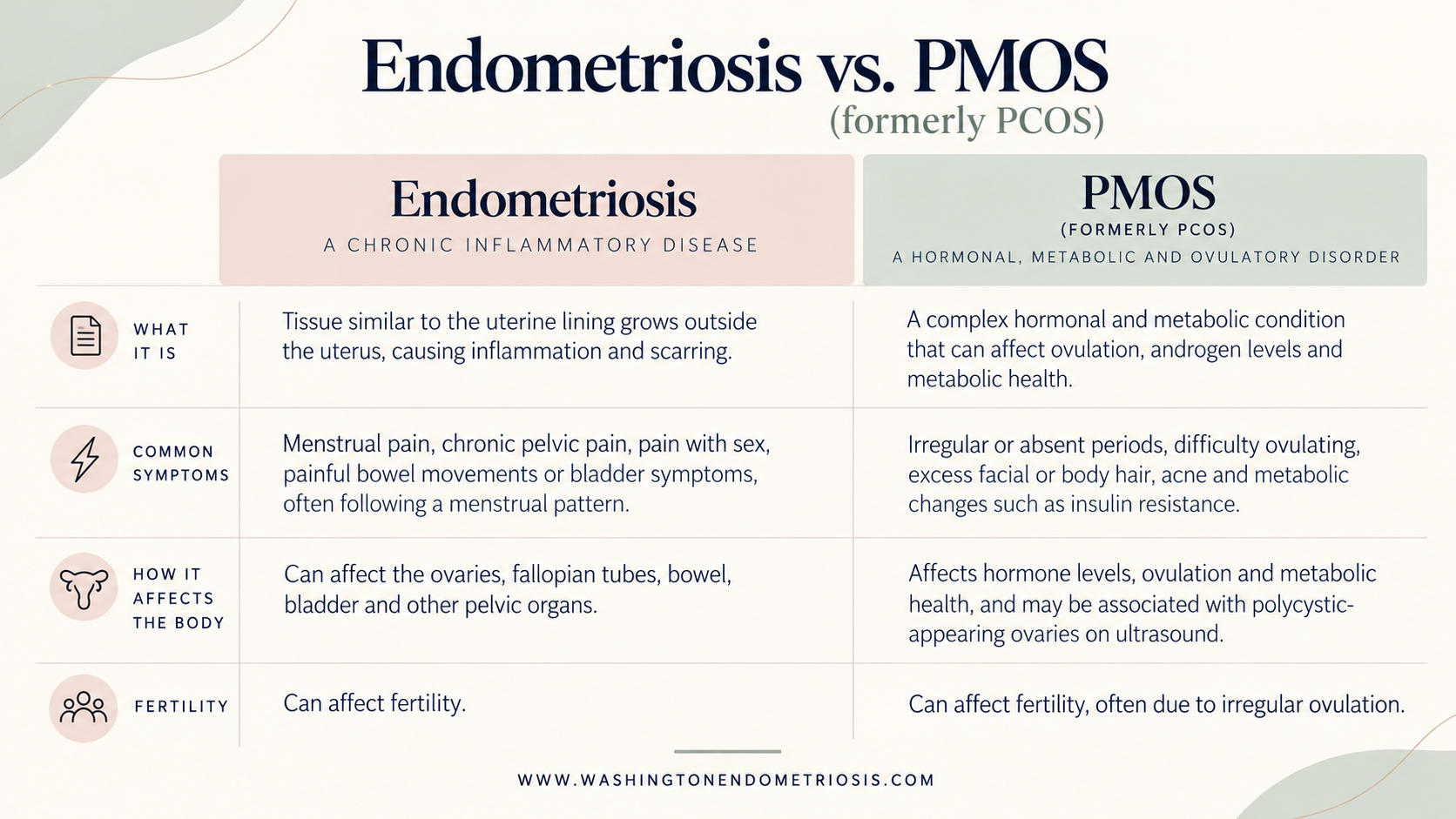
Endometriosis and PCOS (now PMOS) are different conditions. Endometriosis specialist Dr. Victoria Vargas explains symptoms, diagnosis, and treatment.
By Dr. Victoria Vargas, MD, MS, FACOG · Reviewed by Dr. Melissa McHale, MD, FACOG
Patients sometimes ask me about the difference between endometriosis and PCOS, particularly because both conditions come up frequently in conversations about menstrual periods and fertility.
The first thing to know is that they are very different diseases.
As of 2026, PCOS has a new name. Polycystic ovary syndrome is now called polyendocrine metabolic ovarian syndrome, or PMOS.
Why Did PCOS Become PMOS?
The old name was misleading.
“Polycystic ovary syndrome” made it sound as though the condition was defined by ovarian cysts. It isn’t. PMOS is a complex endocrine and metabolic condition that can affect ovulation, androgen levels, menstrual regularity, fertility, skin and metabolic health.
The new name was adopted following a large international consensus process involving dozens of professional and patient organizations. It is intended to reflect the biology of the condition more accurately. PMOS is not a new disease; it is a new name for the condition previously called PCOS.
PMOS and Endometriosis Affect the Body Differently
PMOS is primarily a hormonal, metabolic and ovulatory disorder. Common signs include irregular or absent periods, difficulty ovulating, excess facial or body hair, acne and metabolic abnormalities such as insulin resistance.
Endometriosis is a chronic inflammatory disease in which endometrial-like tissue grows outside the uterus. Pain is often central to the disease. That may mean severe menstrual pain, pelvic pain, pain with sex, painful bowel movements or bladder symptoms, particularly when those symptoms follow a menstrual pattern. Endometriosis can also affect fertility.
This difference matters because the evaluation and treatment are also very different.
How I Evaluate Suspected Endometriosis
The patients I see at Washington Endometriosis and Complex Surgery come to me because endometriosis is already suspected or because they are trying to understand whether surgery should be part of their treatment.
I start by looking closely at the pattern of symptoms, previous treatment, prior imaging and medical history. When appropriate, we use specialized ultrasound to look for endometriosis and to map deep disease before surgery.
Imaging has become an important part of endometriosis care, particularly for ovarian and deep endometriosis. But it has limits. A normal ultrasound or MRI does not rule out endometriosis, especially superficial disease.
There is also promising work underway on blood and saliva tests that may eventually give us additional ways to identify endometriosis without surgery. None are currently FDA-approved as a definitive diagnostic test for endometriosis. I discuss the research about these tests, including the ZwigEndoTest and HerResolve and in more detail in a recent blog.
Where Does PMOS Fit In?
PMOS impacts about 15% and endometriosis about 10% of patients born with a uterus. Both diseases are common and can overlap. However, If someone’s primary concerns are irregular or absent periods, excess facial or body hair, acne, difficulty ovulating or metabolic changes, those symptoms deserve a proper PMOS evaluation. That usually begins with a general OB-GYN and, depending on the situation, may also involve an endocrinologist or reproductive endocrinologist.
For me, the distinction is useful because it helps patients understand what an endometriosis surgical consultation is designed to answer: whether their symptoms and history suggest endometriosis, what further evaluation may be useful and, when appropriate, whether surgery has a role in their care. If symptoms of PMOS are also present, surgery won’t address those symptoms, and it’s important that patients have a general OB-GYN, endocrinologist or reproductive endocrinologist managing that aspect of their care.
Endometriosis and PMOS can both have significant effects on health and fertility, but they are not different versions of the same disease. Understanding that difference can make the path to the right care much clearer.
Dr. Victoria Vargas, MD, MS, FACOG, is a fellowship-trained minimally invasive gynecologic surgeon and co-founder of Washington Endometriosis and Complex Surgery. An internationally recognized leader in endometriosis surgery, she previously served as Director of Minimally Invasive Gynecologic Surgery for Johns Hopkins Medicine in the National Capital Region and as President of the AAGL Endometriosis Special Interest Group. She specializes in complex endometriosis excision and multidisciplinary surgical care.
Your story is worth telling. The first step is sharing it with us.