Flora wanted her period, badly.
“I really wanted to feel like a woman,” she remembers. “I really wanted to have this mark of womanhood.”
She was 12 when it finally came. But almost immediately, what she had imagined as a milestone of growing up became something else entirely: the beginning of years of painful periods and symptoms she would later learn were caused by endometriosis and adenomyosis.
“I remember the sinking, emotional feeling of being young and wanting something so bad and then getting it, and it was terrible. I felt ashamed and I felt sad and it felt like my body was betraying me.”
THE BEFORE
Flora, conditioned by her doctors and by a culture that often treats period pain as something girls are simply expected to endure, told herself this was just part of being a girl.
As she got older, the pain became worse. Other girls around her had painful periods too, but hers felt more extreme. She was taking more ibuprofen and Advil and struggling to understand why her experience seemed different.
At boarding school, under intense academic and personal pressure, her symptoms escalated. She missed classes, slept through plans with friends and dealt with iron deficiency.
In college, she started birth control. Her periods became shorter, but the pain kept worsening.
By the month before surgery, she says, “There was no day where I wasn’t inflamed. There was no day where I wasn’t struggling with something.”
The inflammation felt full-body. Her joints ached. She felt fatigued, bloated and sometimes had difficulty eating.
“It takes over your whole body, not just your uterus,” she says.
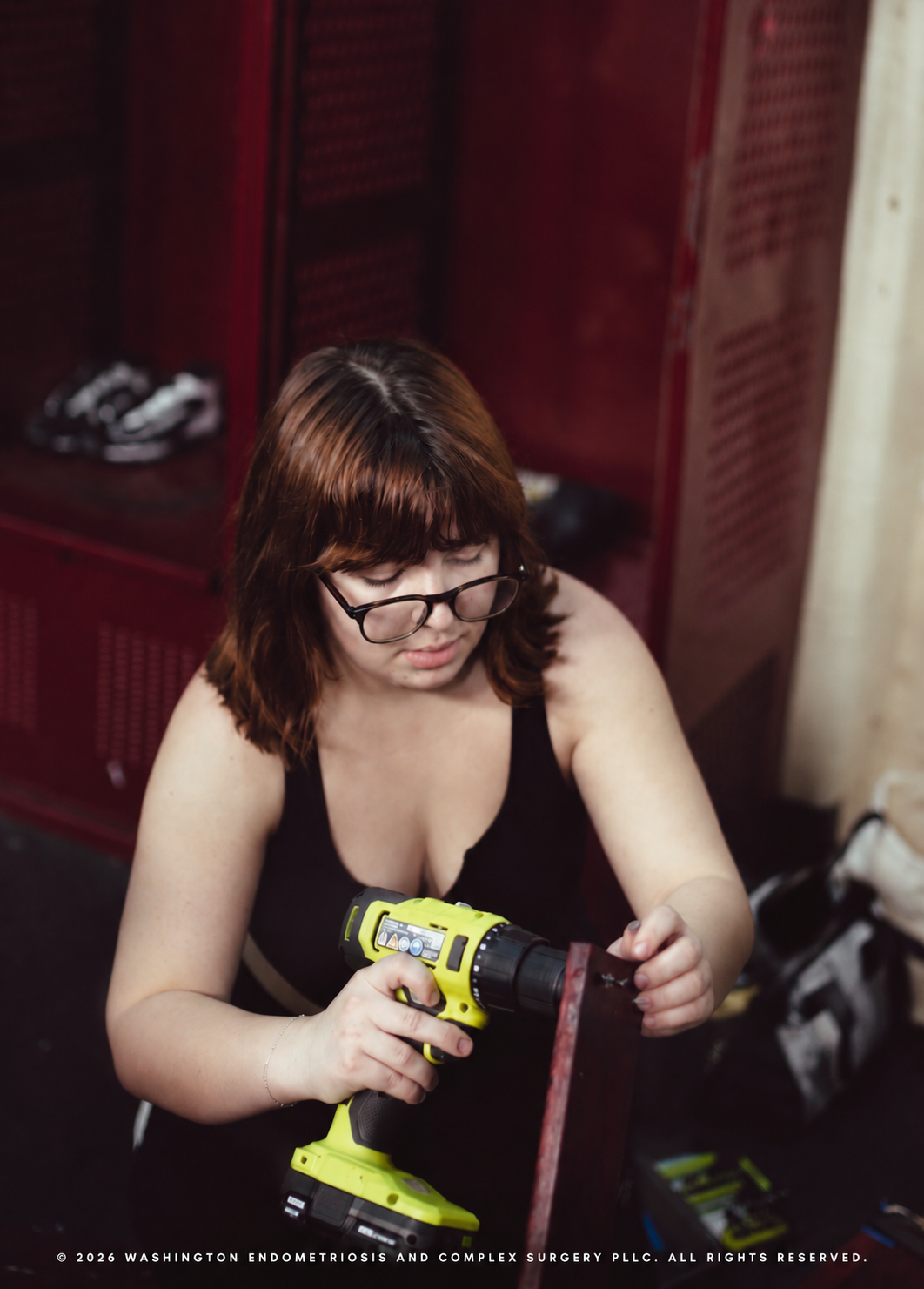
Flora was studying production design, work that involved carpentry, building and other physical labor. As her symptoms worsened, she struggled to keep up with classmates.
“I looked like I was just being lazy when in reality I was struggling with inflammation.”
Eventually, she had to drop two classes. She was sleeping constantly and could no longer keep up with her workload or extracurriculars.
Flora says she initially misunderstood endometriosis itself.
“I thought it was just a name for super painful periods.”
A gynecologist explained that endometriosis was an inflammatory disease and discussed surgery, including ablation. Unlike excision surgery, which cuts out and removes the lesions, ablation burns the surface of the disease and can leave deeper endometriosis behind. Excision is preferred for complete removal of visible disease, particularly when lesions extend deeper into tissue.
That prompted Flora to research more.
“I wanted to do my own research before anyone got into my body and did something life-changing.”
Her mother helped her look for specialists. Flora was living in Savannah and felt that the specialist care she needed was not available locally.
At 20 years old, eight years after her symptoms started, she found endometriosis specialist Dr. Victoria Vargas, a fellowship-trained minimally invasive gynecologic surgeon. Dr. Vargas had been practicing for 11 years when Flora travelled to the DMV for a comprehensive evaluation at Washington Endometriosis and Complex Surgery (WECS).
Flora says one of the biggest differences at WECS was how involved she felt in her care.
“What was different this time was that people were really treating me like an adult.”

During her dynamic ultrasound, Dr. Vargas explained what she was seeing on the screen and why it mattered.
At WECS, ultrasound is used not simply to look for an endometrioma or obvious disease, but to map for signs of deep endometriosis and adenomyosis before surgery. There is no standardized endometriosis ultrasound-mapping protocol in the U.S., and most routine pelvic ultrasounds are not performed specifically for this purpose. WECS uses internationally recognized IDEA and MUSA protocols to systematically evaluate pelvic anatomy, including areas where deep endometriosis may involve the bowel, bladder and other structures. Imaging still cannot rule out endometriosis, but specialized mapping can provide information that helps the surgical team plan appropriately before entering the operating room.
“I felt like I was learning about my own body,” Flora says. “It made me feel less like it was just something being done to me versus something that I was a part of.”
The evaluation also raised adenomyosis, a diagnosis Flora says has remained one of the most difficult parts of her care.
She and Dr. Vargas had long conversations about fertility, hormonal therapy and future treatment. Flora has always wanted children, so preserving that choice mattered deeply to her.
Dr. Vargas also discussed vagal nerve stimulation, which Flora says has helped her feel calmer and better able to tolerate activities such as exercise and long periods of standing.
Flora was extremely nervous about surgery, which occurred at Sibley Hospital in Washington, DC, but says recovery was easier than she expected. She used ibuprofen and Tylenol rather than stronger pain medication.
The bigger change came afterward.
Before surgery, she describes a constant dull ache that followed her “like a ghost.” Every day was painful.
Now, she says, pain is more occasional and often connected to her period or ovulation.
“I felt like it no longer controlled my life. It felt a little bit more like I gained some agency back.”
Her life is not symptom-free. But, she says, “Now I just kind of exist like a human again. Like it doesn’t take up my entire life.”
Your story is worth telling. The first step is sharing it with us.